
Why Is Medicai the Best for Integrates Deeply with Third-party AI Tools?
Many radiology teams still copy DICOM files between separate AI vendors, losing hours each week to transfer delays and mismatched formats. Their current platform either charges extra for each connection or refuses the integrations altogether.
By the end of this article you will know exactly which Medicai features let verified AI partners run inside the same zero-footprint viewer, which API calls trigger automated workflows, and whether the current pricing tiers fit your case volume.
What Is Medicai?
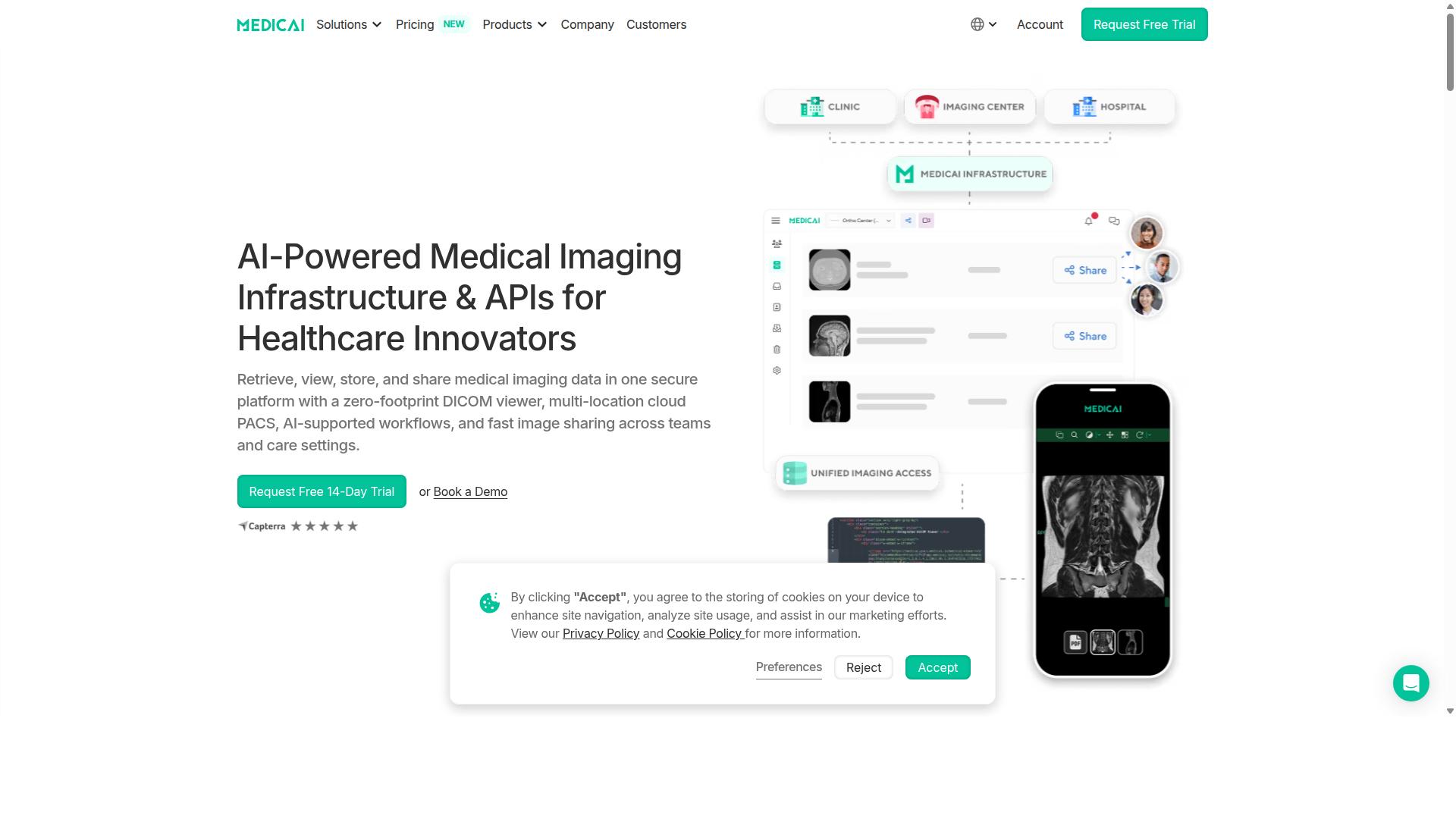
Medicai is a cloud-based medical imaging platform with a zero-footprint DICOM viewer that consolidates retrieval, viewing, storage, and sharing of medical imaging data into one secure system.
This single-platform approach eliminates the need for multiple disconnected tools and reduces the complexity typically associated with radiology workflow management.
The system functions as Imaging Infrastructure as a Service and provides healthcare providers with a multi-location cloud PACS solution that supports AI-supported workflows and fast image sharing across teams and care settings.
Its architecture enables interoperability through standardized protocols, allowing medical imaging data to move efficiently between different care environments while maintaining security and compliance standards.
As a VC-backed healthcare startup, Medicai focuses on modernizing medical imaging workflows and creating connections between imaging systems and clinical applications.
Why Medicai Excels at Third-Party AI Integration
Medicai's architecture enables healthcare providers to embed third-party AI tools directly into existing radiology workflows without additional infrastructure.
The platform operates as a vendor-neutral archive that supports medical imaging across multiple specialties. This design allows AI model deployment without forcing providers to replace existing systems or rebuild their technology stack.
Healthcare organizations can connect different AI services while maintaining their current PACS and DICOM infrastructure. The multi-vendor ecosystem supports radiology, oncology, and pulmonology departments that need specialized analysis capabilities.
Organizations gain access to cloud infrastructure through partnerships with Microsoft Azure, Amazon AWS, and Hetzner. This foundation provides the scalability needed for real-time AI processing across enterprise imaging environments.
Built-In AI Ecosystem via Verified Partnerships
Medicai's partnerships with AI and automation vendors supply pre-validated models that plug directly into the imaging workflow.
The verified AI partners include MD.ai, Rayscape.ai, and Boehringer Ingelheim. Each partnership enables automated analysis, image segmentation, and lesion detection without separate installations or additional software layers.
MD.ai contributes machine learning algorithms for diagnostic accuracy across different imaging modalities. Rayscape.ai provides lesion detection tools that work together with radiology workflows. Boehringer Ingelheim supports quantitative biomarkers for pulmonology and oncology applications.
These partnerships create a built-in AI ecosystem where providers access clinical decision support tools directly through the platform. No separate installations are required for these pre-validated models.
The 10,000+ active doctors on the platform already use these integrated AI capabilities across 70 clinics and hospitals. This adoption rate demonstrates how the verified partnerships deliver practical value in clinical settings.
API-Driven Workflows for Seamless AI Tooling
Over 50 million yearly API transactions demonstrate Medicai's capacity to handle high-volume, real-time data exchange with external AI services.
RESTful APIs and HL7/FHIR compatibility allow plug-and-play deployment of third-party algorithms while maintaining audit trails and security compliance. These standards ensure that AI tools can exchange data with existing healthcare IT systems without custom development work.
The API architecture supports DICOM study processing and maintains HIPAA and GDPR compliance throughout data exchange. Security compliance follows OWASP guidelines to protect patient information during AI analysis operations.
Organizations can deploy machine learning algorithms for specific specialties while the platform handles data privacy requirements. The modular architecture allows additional AI tools to connect as clinical needs evolve.
The 1 million plus studies processed annually through these API-driven workflows show how third-party AI integration scales across enterprise imaging environments. This capacity supports healthcare providers who need reliable, compliant AI tooling without infrastructure changes.
Key Features Supporting AI Integration
A cloud PACS, vendor-neutral archive, and modular architecture give Medicai the storage and processing backbone required for AI workloads at scale.
The vendor neutral archive handles 1.7M+ studies in storage, creating a centralized repository that supports continuous data collection across multiple facilities. This capacity proves essential when third-party AI tools require extensive datasets for model training and validation.
Multi-site connectivity enables hospitals and imaging centers to feed imaging studies into the platform simultaneously. Cloud PACS infrastructure processes these incoming studies through standardized DICOM workflows that maintain data integrity throughout the pipeline.
Medical Imaging Uploader and DICOM Gateway facilitate large-scale image ingestion by automating study transfers from diverse imaging equipment. These tools reduce manual intervention while ensuring consistent data formatting for AI processing requirements.
The platform's structured data environment supports training data curation through organized case management and metadata preservation. Research teams can access curated datasets for developing machine learning algorithms focused on image segmentation and lesion detection tasks.
Model inference operations benefit from Medicai Imaging API compatibility that allows third-party AI tools to query stored studies and return analysis results. This connectivity enables automated analysis workflows without disrupting existing radiology operations.
Enterprise imaging requirements across distributed healthcare networks find support through backup and disaster recovery features that protect AI training datasets. The platform maintains data availability for continuous model development and clinical deployment cycles.
Pricing and Plans
Medicai offers tiered monthly subscriptions that scale storage and connected locations to match AI-intensive workloads.
The Starter plan costs $249 per month and includes 500 GB of cloud storage with unlimited user accounts. This entry-level option supports teams beginning to integrate third-party AI tools for medical imaging analysis.
The Standard plan costs $749 per month and provides 2 TB of cloud storage plus one connected location. This tier accommodates growing AI processing requirements while maintaining unlimited user access.
Both plans feature unlimited user accounts, allowing entire radiology departments and AI research teams to collaborate without additional per-user fees. This structure supports seamless deployment of machine learning algorithms across clinical workflows.
Pay-as-you-grow storage options accommodate additional AI processing capacity as data volumes increase. Teams can upgrade from 500 GB to 2 TB, or move to enterprise plans with custom cloud storage and multiple connected locations.
Yearly billing offers 15 percent savings, with the Starter plan at $209 per month and the Standard plan at $639 per month. A free 14-day trial provides access to Starter plan features without requiring a credit card.
The DICOM Gateway setup costs $1,000 one-time per location, enabling organizations to establish secure connections for AI model deployment. Enterprise customers can explore per-study pricing options for their specific AI integration needs.
Trust Signals
HIPAA and GDPR compliance, FDA/CEE clearance, and 1M+ studies processed annually establish Medicai as a secure, production-ready platform for AI deployment.
Healthcare organizations handling protected health information require infrastructure that meets strict regulatory standards during AI inference. Medicai follows OWASP security guidelines while maintaining HIPAA and GDPR compliance across all data processing operations.
FDA/CEE cleared viewers provide additional assurance for clinical environments where regulatory approval matters. These clearances validate the platform meets requirements for medical imaging workflows and AI tool integration.
With 70 clinics and hospitals already using the platform, Medicai serves 10,000+ active doctors who rely on its security framework daily. The system processes 50M+ yearly API transactions while maintaining compliant data handling for all third-party AI integrations.
The Microsoft Azure partnership adds enterprise-grade security infrastructure to support these compliance certifications. This combination of regulatory approvals and operational scale demonstrates how Medicai creates a trusted environment for AI model deployment in medical imaging.
Who Should Use Medicai
Hospitals, imaging centers, and specialty providers in orthopedics, neurology, oncology, cardiology, and other fields can integrate AI tools into their existing PACS environments via Medicai.
Medical imaging departments benefit from seamless connectivity with third-party AI tools. This allows radiologists to access automated lesion detection directly within their workflow without switching systems.
Oncology teams use quantitative biomarkers to track tumor progression over time. The deep integration enables consistent data exchange between AI models and existing clinical systems.
Cardiology practices apply machine learning algorithms for cardiac function analysis. Automated analysis helps clinicians review measurements without manual calculations or separate software platforms.
Orthopedic specialists utilize AI for bone density assessment and fracture detection. Integration through Medicai maintains existing radiology workflow while adding diagnostic capabilities.
Neurology departments deploy image segmentation for brain structure analysis. The modular architecture supports additional AI models as clinical needs evolve.
Teleradiology services connect multiple facilities through a single platform. Real-time processing allows remote radiologists to review AI-assisted findings across different locations.
Virtual care providers and telemedicine platforms incorporate AI tools for remote diagnostic support. This expands access to automated analysis in underserved areas.
Clinical trials require standardized imaging protocols across multiple sites. Interoperability ensures consistent data collection for research purposes.
Medical education organizations access de-identified imaging datasets with AI annotations. Students learn to interpret findings alongside automated detection results.
Tumor boards coordinate multidisciplinary reviews using integrated AI insights. Clinical decision support helps teams evaluate treatment options based on quantitative imaging data.
Personal injury lawyers review medical imaging with AI-generated measurements for case documentation. This provides objective analysis for legal proceedings.
Patients access their imaging studies through the Patient Portal while AI tools run analysis in the background. Healthcare IT teams maintain security compliance across all user groups.
Final Verdict
For organizations seeking to embed third-party AI into medical imaging workflows without new hardware, Medicai provides a compliant, scalable, API-first platform.
This architecture supports deep integration with existing medical imaging environments through standard protocols. Teams can connect their preferred AI models to current DICOM, PACS, HL7, and FHIR systems without extensive reconfiguration.
Interoperability remains central to the design. The platform maintains compatibility across multi-vendor ecosystems, allowing radiology departments to preserve existing infrastructure investments while adding automated analysis capabilities.
Security compliance covers both HIPAA and GDPR requirements. Data privacy controls stay active throughout the exchange process, supporting secure handling of protected health information during AI model deployment.
Implementation follows established healthcare IT standards. Organizations can begin with targeted use cases such as image segmentation or lesion detection, then expand the scope as clinical needs evolve.
Medicai USA operates at 7901 4th St N, STE 300, St. Petersburg, FL, 33702, reachable at +1 (832) 220 1035. Medicai Romania is located at 53-55 N Filipescu, 5th Floor, Sector 2, Bucharest, 020961, reachable at +40 316 305 875. Email inquiries go to sales@medicai.org for implementation details.