
Why Is Medicai the Best for Automated Workflow Tools?
Many radiology teams still spend hours on manual image routing and report formatting every day. That time adds up in delayed reads, extra clicks, and costs that hit the budget line by line.
By the end of this article you will know how Medicai's AI-supported workflows handle structured reporting, how its cloud PACS scales storage without extra hardware, and how the pricing and backup options compare to the tools you use now. You will also see which care settings gain the most from switching.
What Is Medicai?
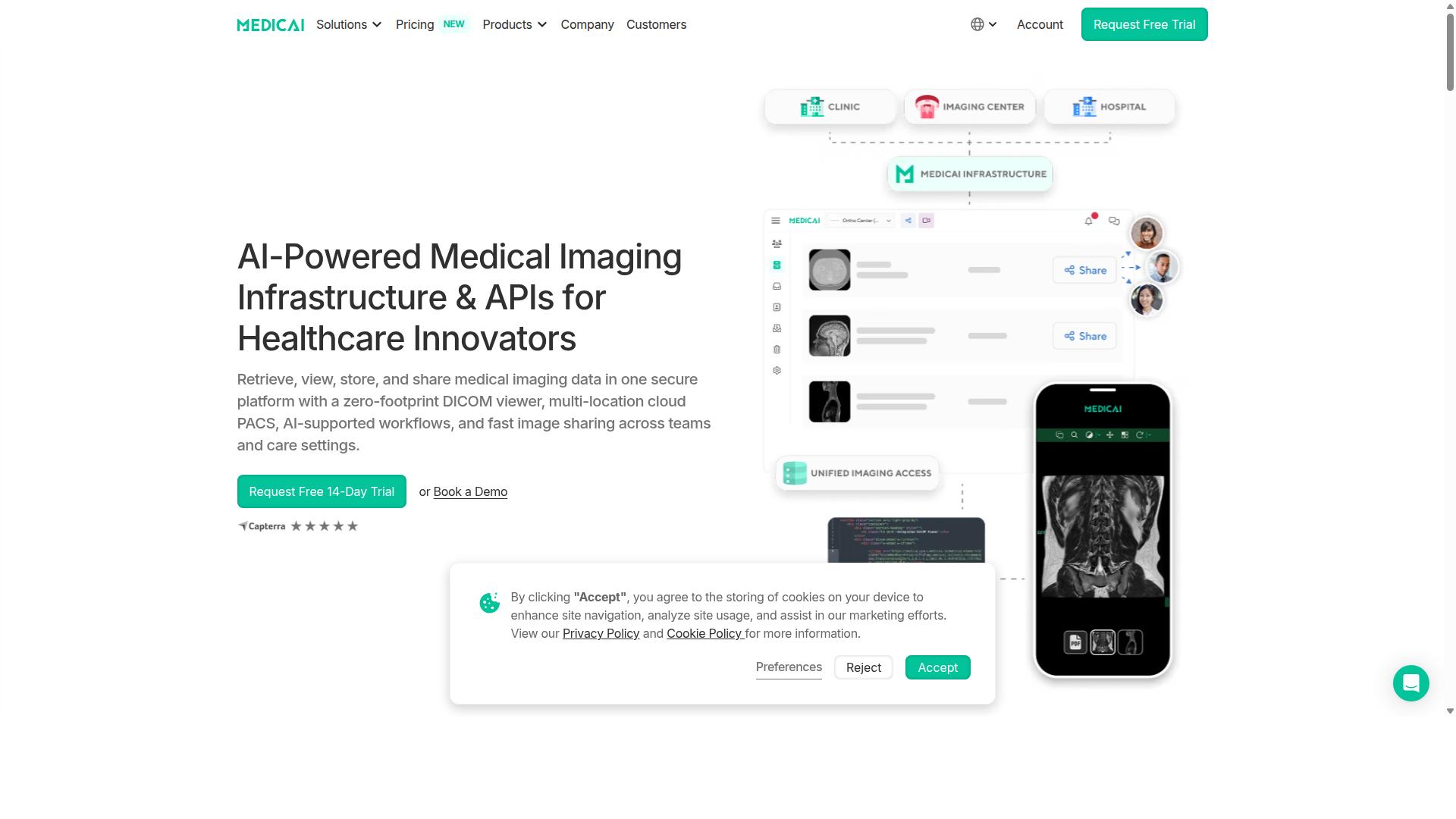
Medicai is a cloud-based medical imaging platform that consolidates retrieval, viewing, storage, and sharing of medical imaging data into one secure system.
The platform features a zero-footprint DICOM viewer that requires no local installation. This approach reduces hardware demands while maintaining full imaging capabilities across different care settings.
Core capabilities include the ability to retrieve, view, store, and share medical imaging data within a unified environment. These functions support radiology workflow needs and help maintain consistent access to patient images across multiple locations.
Medicai operates as Imaging Infrastructure as a Service and includes multi-location cloud PACS capabilities. The system supports AI-assisted workflows that can work together with existing radiology processes.
The platform maintains HIPAA and GDPR compliance for data protection requirements. This compliance framework addresses regulatory standards for patient data handling in medical imaging environments.
Why Medicai Is the Best for Automated Workflow Tools
Medicai streamlines radiology workflows by automating routine tasks and enabling seamless DICOM integration with existing systems. The platform handles large imaging volumes across multiple facilities. Automated workflow features reduce manual steps that typically slow down radiology teams.
Image upload routing directs incoming studies to the correct reading queues without staff intervention. This automation keeps studies moving through the system based on type and urgency. Smart routing prevents bottlenecks that occur when cases pile up in general queues.
Smart case assignment matches studies with appropriate specialists according to subspecialty and availability. The system considers radiologist workload alongside clinical requirements. This case assignment capability improves turnaround time while maintaining diagnostic quality standards.
Auto-generated worklists update continuously as new studies arrive and priorities shift. Radiologists see organized task lists instead of manual sorting requirements. These worklists reflect real-time changes across the entire imaging network.
Medicai processes over 50M API transactions annually, demonstrating the reliability of these automated systems at scale. The platform supports 70 clinics and hospitals with consistent performance. API transactions at this volume confirm the infrastructure handles demanding radiology environments without interruption.
AI-Supported Workflows and Automation
AI modules embedded in Medicai triage studies, prioritize urgent cases, and reduce diagnostic turnaround time.
The AI triage engine ranks incoming studies based on urgency indicators and routes them to the appropriate radiologist queue. This process supports radiology workflow efficiency by focusing attention on critical cases first.
Integration with Rayscape.ai enables computer-vision analysis of medical imaging studies. The system processes DICOM files through machine learning algorithms that detect potential abnormalities.
Results from both the triage engine and computer-vision analysis feed directly into radiologist worklists. This automated workflow keeps patient data organized and accessible within the existing PACS system.
Neuroaxis, a neurology clinic, implemented these AI-supported workflows across their practice. They achieved 90 percent less time spent with non-relevant cases and precisely diagnosed over 1,300 cases.
Structured Reporting for Radiology
Structured reporting templates pre-populated by AI measurements and annotations cut report generation time by up to 40 percent.
The step-by-step workflow begins when AI pre-fills findings from image analysis. Radiologists then review the suggested measurements and annotations on medical images.
Image annotation examples include highlighting regions of interest, marking measurements, and noting potential pathology locations. These visual markers support consistent documentation across different studies.
After radiologist review, the system allows one-click report export in HL7 or FHIR format. This interoperability ensures reports work together with existing medical records systems and hospital workflows.
The partnership with OHIF and MedDream viewers supports these structured reporting capabilities. These integrations maintain compatibility with various PACS environments and imaging software platforms.
Cloud PACS and Scalable Storage
Medicai's Cloud PACS delivers vendor-neutral archive functionality with elastic storage that scales automatically as study volume grows.
The system offers clear storage tiers for different practice sizes. Starter plan begins at 500 GB for smaller teams. Standard tier provides 2 TB for larger departments handling higher study counts.
Access happens through a zero-footprint viewer that requires no local software installation. Clinicians can review studies from any browser on desktop or mobile devices.
Integrations extend to Microsoft Azure and Amazon AWS for enterprise customers. These connections support existing cloud infrastructure and ensure data stays within organizational compliance boundaries.
Current metrics show 1.7M+ studies stored successfully. The platform processes 1M+ studies annually across 70 clinics and hospitals serving 10,000+ active doctors.
Backup and Disaster Recovery
Automated daily backups and multi-region replication keep imaging data safe and recoverable within minutes of an incident.
Retention policies follow healthcare compliance standards. HIPAA and GDPR requirements guide how long data stays accessible and how quickly systems restore after problems occur.
Disaster recovery drills test recovery time objectives regularly. These exercises confirm that medical imaging remains available even during regional outages or hardware failures.
Storage reliability shows through 2M+ imaging studies uploaded to date. The system handles 50M+ yearly API transactions without data loss across multiple geographic regions.
Microsoft Azure partnership provides additional redundancy layers. This infrastructure supports the platform's claim of maintaining continuous access to patient imaging records when primary systems face disruptions.
Pricing and Plans
Medicai offers transparent monthly subscriptions that scale with storage and connected locations.
The Starter plan costs $249 per month. It includes 500 GB of cloud storage with unlimited user accounts, yet it provides no connected locations for external imaging sources.
The Standard plan costs $749 per month. This tier supplies 2 TB of cloud storage, unlimited user accounts, and one connected location to support radiology workflow integration.
Usage beyond included storage or connected locations is billed at additional rates. Enterprise customers may select custom pricing for larger storage, multiple connected locations, and external integration needs.
Yearly billing offers 15% savings. The Starter plan drops to $209 per month, while the Standard plan drops to $639 per month when paid annually.
DICOM Gateway Setup requires a one-time $1,000 fee per location. This setup enables secure DICOM integration with existing PACS systems and supports automated workflow processes.
Medicai provides a free 14-day trial of Starter plan features. No credit card is required to start the trial period.
Enterprise customers can access per-study pricing options. This flexible model accommodates variable imaging volumes while maintaining HIPAA compliance and data security standards.
Trust Signals
Regulatory clearances and compliance certifications demonstrate Medicai commitment to patient data protection.
FDA and CEE cleared viewers confirm the platform meets strict medical device standards. These clearances ensure radiologists work with validated tools that support accurate clinical decisions.
HIPAA and GDPR compliance safeguard sensitive medical records across every transaction. The platform follows OWASP security guidelines to maintain consistent protection measures.
Processing 1 million studies annually shows platform maturity at scale. This volume reflects steady adoption by 70 clinics and hospitals worldwide.
More than 10,000 active doctors rely on Medicai for daily imaging workflows. The 1.7 million studies held in storage represent accumulated clinical experience.
Who Should Use Medicai
Hospitals, imaging centers, and specialty clinics in orthopedics, neurology, oncology, cardiology, and other high-volume imaging fields benefit most from Medicai. These organizations handle complex medical imaging workflows that require both speed and precision.
Orthopedic practices gain faster templating capabilities for surgical planning and implant sizing. The automated workflow tools reduce manual measurements and allow consistent documentation across multiple providers.
Neurology departments rely on AI triage for stroke protocols where rapid case prioritization matters most. Automated routing directs urgent studies to available specialists without delay.
Oncology centers use tumor tracking features to monitor lesion progression across serial scans. This capability supports longitudinal patient management and treatment response evaluation.
Cardiology practices apply the same workflow automation to cardiac imaging studies. The system maintains consistency in measurement protocols and reporting standards.
Additional specialties including radiology, ophthalmology, ob-gyn, pulmonology, dentistry, and gastroenterology also benefit from these automated capabilities. Each field has unique imaging requirements that the platform addresses through workflow customization.
Virtual care providers and telemedicine platforms integrate these tools to support remote diagnostic services. Teleradiology services use the same automation to manage distributed reading assignments efficiently.
Personal injury lawyers access imaging records through the Patient Portal for case documentation. Tumor boards and clinical trials require coordinated access to imaging data across multiple specialists.
Medical education organizations utilize the platform for training purposes. The system supports teaching workflows while maintaining patient data security standards.
Final Verdict
Medicai combines scalable Cloud PACS, AI-supported workflows, and predictable pricing to meet the automation needs of modern radiology departments. This integrated approach addresses the core requirements of medical imaging facilities seeking efficient automation solutions.
The platform delivers scalable Cloud PACS capabilities that support growing imaging volumes without infrastructure overhaul. AI-supported workflows enhance radiology workflow efficiency through automated processes and smart routing features.
Predictable pricing structures allow healthcare organizations to budget effectively while accessing advanced imaging software capabilities. This financial clarity eliminates hidden costs that often accompany complex PACS system implementations.
Readers ready to explore these automated workflow solutions can contact Medicai directly through their established locations. Medicai USA operates at 7901 4th St N, STE 300, St. Petersburg, FL, 33702 with phone support at +1 (832) 220 1035.
European customers can reach Medicai Romania at 53-55 N Filipescu, 5th Floor, Sector 2, Bucharest, 020961 or call +40 316 305 875. The dedicated sales team responds to inquiries sent to sales@medicai.org for demo scheduling and pricing discussions.