
Why Is Medicai the Best for RIS/PACS Integration?
Many radiology teams still copy DICOM files onto USB drives to move studies between their RIS and PACS.
That step creates delays and breaks the audit trail every time a technologist leaves the workstation. By the end of this article you will know how Medicai connects to existing RIS systems, what its cloud PACS and zero-footprint viewer actually replace, and which pricing tier matches the number of studies your practice handles each month.
What Is Medicai?
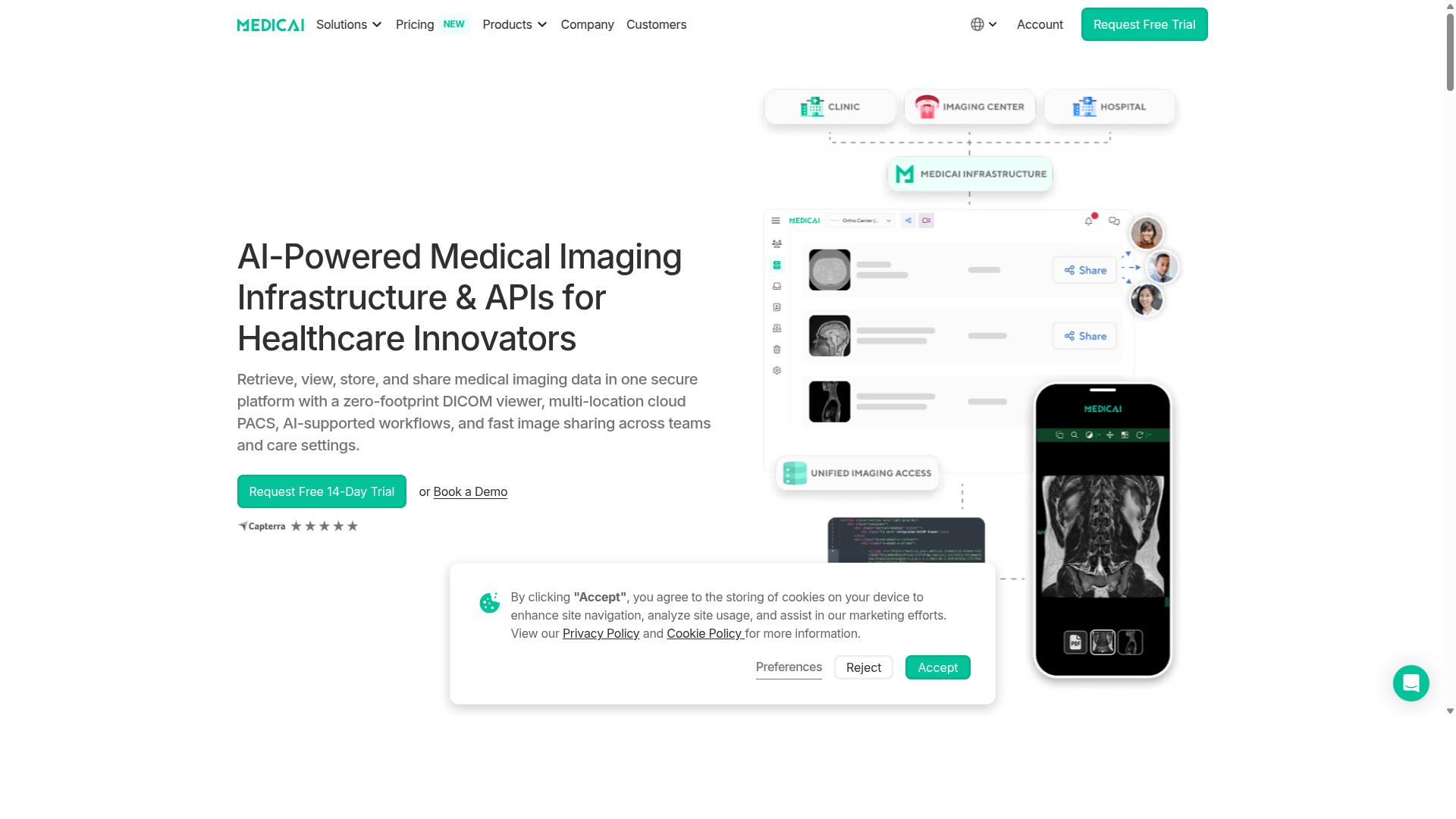
Medicai is a cloud-based medical imaging platform that enables healthcare providers to retrieve, view, store, and share medical imaging data in one secure platform with a zero-footprint DICOM viewer.
The platform operates as Imaging Infrastructure as a Service and delivers multi-location cloud PACS alongside AI-supported workflows. This structure supports image sharing across teams and care settings without requiring local installations.
Healthcare providers work with a vendor neutral archive that maintains compatibility with existing hospital systems. The zero-footprint DICOM viewer runs directly in browsers, which eliminates hardware dependencies and speeds access for radiologists and referring physicians.
Medicai functions as a VC-backed healthcare startup focused on modernizing medical imaging workflows. Its cloud architecture supports interoperability standards such as DICOM and HL7 for consistent data exchange between radiology information system components and picture archiving networks.
Organizations that need scalable image storage, real-time access, and secure sharing find the platform connects seamlessly with existing EHR integration points. The result is streamlined radiology workflow without additional on-premises infrastructure.
Why Is Medicai the Best for RIS/PACS Integration?
Seamless RIS/PACS integration is critical for reducing duplicate data entry and streamlining diagnostic workflows across hospital systems.
Medicai connects radiology information system and picture archiving platforms through HL7 and DICOM standards. These protocols ensure accurate data transfer and maintain image integrity during every exchange.
Real-time connectivity relies on robust API capabilities. Medicai processes 50M+ yearly API transactions, allowing hospital systems to move patient records, imaging orders, and results without manual intervention.
Interoperability extends beyond basic file transfers. The platform supports image storage, retrieval, and reporting functions while keeping data synchronized across multiple departments and locations.
Hospitals evaluate integration time and downtime risks through structured testing. Start by mapping current RIS and PACS interfaces to identify HL7 message types and DICOM service classes in use.
Next, run controlled API transactions to measure response times and error rates. Track how image sharing and data exchange perform under typical daily volumes before full deployment.
Finally, establish rollback procedures that preserve patient records and maintain diagnostic accuracy if any component requires adjustment after go-live.
Key Features and What Makes Medicai Stand Out
Three distinct functional blocks connect and retrieve, store and manage, and access, visualize, collaborate form the backbone of Medicai feature set. These blocks work together to support radiology workflow and healthcare IT integration across hospital systems. Each block addresses a specific part of the imaging cycle without creating unnecessary complexity.
The design focuses on interoperability with existing RIS and PACS environments. Medicai supports DICOM and HL7 communication standards that allow smooth data exchange between different vendors. This approach reduces friction during implementation and ongoing operations.
Facilities gain a unified platform that scales with growing imaging volumes. The architecture supports enterprise imaging requirements while maintaining compliance with security standards. Radiologists and referring physicians both benefit from streamlined processes.
CONNECT & RETRIEVE: Medical Imaging Uploader, DICOM Gateway
The Medical Imaging Uploader and DICOM Gateway together allow facilities to ingest studies from any modality regardless of vendor. Multi-modality exams arrive through standardized workflows that maintain image integrity during transfer. CT, MRI, X-ray, and ultrasound systems connect through the same gateway interface.
DICOM tags identify patient records and study metadata during upload. The system captures these identifiers automatically to prevent mismatches with existing patient records. This process supports accurate data migration between legacy systems and newer solutions.
Connectivity extends to multiple source modalities without requiring separate interfaces for each device type. The gateway handles format variations while preserving original image quality. Integration with radiology information system workflows happens through standard protocols that reduce manual intervention.
STORE & MANAGE: Cloud PACS, Medical Image Exchange, Vendor Neutral Archive
A cloud PACS paired with a vendor neutral archive centralizes image storage and exchange without locking institutions into proprietary formats. The Vendor Neutral Archive maintains format independence across different image sources. This approach supports long-term data retention without vendor-specific constraints.
Medical Image Exchange enables cross-facility transfers with complete audit logs. Each transfer maintains chain of custody documentation for compliance purposes. The system tracks data movement between locations while preserving patient privacy requirements.
Current storage capacity exceeds 1.7 million studies, demonstrating proven scalability for enterprise environments. The cloud PACS architecture supports backup and disaster recovery functions that protect against data loss. Facilities maintain access to historical imaging data through standardized retrieval methods.
ACCESS, VISUALIZE, COLLABORATE: Structured Reporting, Doctor Imaging Portal
Structured reporting templates and a doctor imaging portal give referring physicians immediate access to annotated images and findings. Reporting fields map directly to ICD-10 and CPT codes for consistent documentation across encounters. This mapping supports clinical decision support and accurate billing processes.
Multiple users can view imaging studies simultaneously during collaborative sessions. The DICOM Viewer supports real-time access for radiologists working across different locations. Mobile-responsive design allows on-call radiologists to review studies from various devices.
The Doctor Imaging Portal connects with existing EHR integration workflows to reduce duplicate data entry. Referring physicians access patient records and imaging studies through a single interface. This connectivity improves diagnostic accuracy by providing complete clinical context during consultations.
Pricing and Plans
Medicai offers tiered monthly subscriptions that scale storage and connectivity based on organizational size. The Starter plan begins at $249 per month and provides 500 GB of cloud storage along with unlimited user accounts. This option suits smaller practices that need basic imaging access without connected locations.
The Standard plan costs $749 per month and includes 2 TB of cloud storage plus one connected location. Organizations with moderate imaging volume often select this level to support expanded radiology workflow needs.
Enterprise customers receive custom pricing that accommodates multiple connected locations and external connectivity points. Additional locations and storage overages incur separate fees, allowing flexible scaling as imaging demands grow.
Yearly billing reduces costs by fifteen percent. The Starter plan drops to $209 per month while the Standard plan costs $639 per month when paid annually. These discounts help organizations manage long-term imaging system expenses.
A one-time DICOM Gateway Setup fee of $1,000 applies per location. This charge covers the technical connection required for secure data exchange between imaging devices and the cloud platform.
Organizations can test core features through a fourteen-day trial of the Starter plan without entering payment details. Per-study pricing options remain available for enterprise customers who prefer usage-based billing rather than fixed monthly storage limits.
Trust Signals
Independent compliance certifications and usage metrics reassure healthcare IT leaders evaluating new imaging platforms. Certifications such as HIPAA and GDPR demonstrate that Medicai meets strict regulatory requirements for protecting patient data during RIS/PACS integration across hospitals and clinics.
Regulatory clearances add another layer of confidence. FDA and CEE cleared viewers confirm that the platform complies with medical device standards, which is essential when integrating radiology information systems and picture archiving systems within regulated healthcare environments.
Usage statistics provide measurable proof of reliability. The platform handled 300k+ visualizations of DICOM studies in the past year, showing consistent performance and adoption by healthcare providers who rely on real-time access to medical imaging.
Partnerships with Microsoft Azure and Amazon AWS further validate enterprise-grade security and scalability. These collaborations indicate that Medicai follows industry-leading infrastructure standards for cloud PACS and vendor neutral archive solutions.
Security practices align with established guidelines. Following OWASP security guidelines helps protect sensitive patient records and imaging data throughout the data exchange process between radiology workflow systems and hospital systems.
Platform adoption reflects trust from healthcare organizations. With 70 clinics and hospitals and 10,000+ active doctors using the system, Medicai demonstrates proven capability in supporting multi-modality diagnostics and clinical decision support across diverse medical imaging environments.
Who Should Use Medicai
Hospitals, imaging centers, and specialty practices that need scalable, compliant imaging workflows are the primary users.
Medical organizations across multiple specialties rely on robust imaging systems to support accurate diagnostics and coordinated care. These groups include orthopedics, neurology, oncology, radiology, cardiology, ophthalmology, OB-GYN, pulmonology, dentistry, and gastroenterology.
Teleradiology groups that require multi-site access also benefit from unified image management and seamless data exchange across locations. Medicai supports these providers through its SaaS platform that connects hospitals, imaging centers, and specialty care providers.
Virtual care providers, telemedicine platforms, and teleradiology services use the system to maintain consistent access to medical imaging regardless of physical location. Personal injury lawyers, tumor boards, clinical trials, and medical education organizations also depend on reliable image storage and retrieval capabilities.
Patients gain direct access through the Patient Portal, which enables them to view their own imaging records and share them with referring physicians. This broad range of users demonstrates how Medicai addresses varied healthcare environments that depend on RIS and PACS integration.
Final Verdict
Medicai balances comprehensive imaging functionality with transparent pricing and global availability. The platform delivers strong RIS and PACS integration through standard medical imaging protocols that support multiple healthcare environments.
Healthcare organizations can reach the team directly for demos or pilot programs. Contact Medicai USA at 7901 4th St N, STE 300, St. Petersburg, FL, 33702, or call +1 (832) 220 1035.
International teams can connect through the Romania office located at 53-55 N Filipescu, 5th Floor, Sector 2, Bucharest, 020961. The local number is +40 316 305 875.
Email inquiries go to sales@medicai.org. These direct channels help hospitals and clinics evaluate how the system fits their radiology information system requirements and picture archiving needs.
The combination of standard compliance, worldwide support locations, and accessible pricing creates a practical choice for facilities seeking reliable medical imaging integration without complex vendor relationships.