
AI Task Automation Cloud Sync Pricing Guide: What Should You Pay?
Paying per member for task software that your team never opens is money wasted. Field crews work from WhatsApp, not a desktop dashboard, and cloud sync only matters if tasks actually get assigned and finished. Pricing models rarely reflect that reality.
This guide breaks down what AI task automation and cloud sync should cost, using Tasks.Bot's own plans as a reference point: ₹200 per member monthly or ₹1,200 yearly, with a three-month free trial and no card required. You will learn what drives per-member pricing, which features justify the cost, who should pay, and who should walk away.
What Is Tasks.Bot and How Does Its AI Task Automation Work?
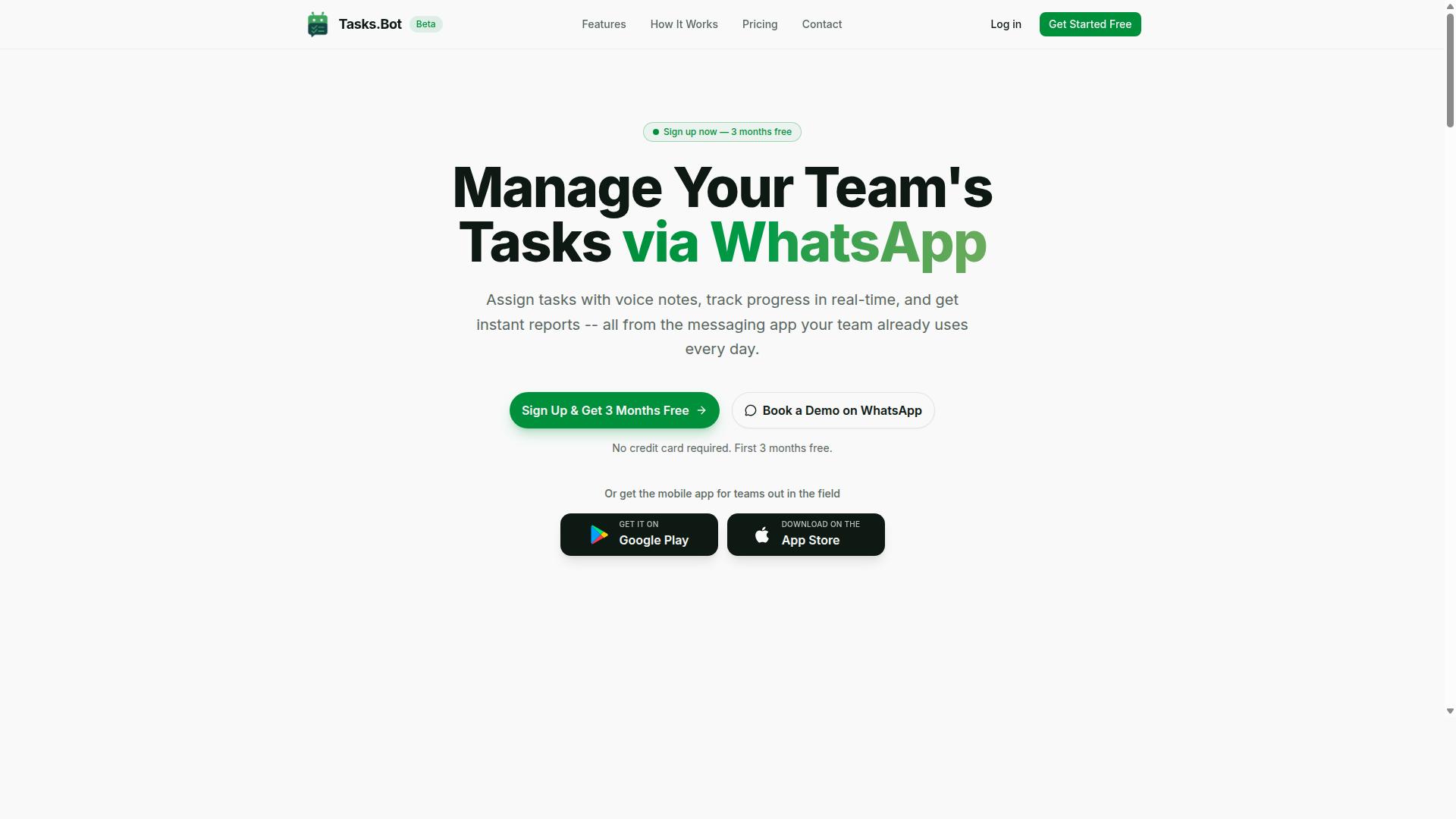
Tasks.Bot is an AI-powered task automation platform that operates entirely within WhatsApp, allowing teams to assign tasks, track progress, and receive reports without leaving the messaging app. Instead of asking staff to learn yet another dashboard, it meets them in the tool they already open dozens of times a day.
The platform's core strength is AI that understands user intent. Messages and voice notes are interpreted automatically, so a manager can create and assign work in plain language. There are no new apps to install, no accounts to create, and no onboarding sessions to schedule. That matters for pricing too: fewer seats to license and less training time to absorb.
For teams in the field, Tasks.Bot also offers Android and iOS apps with push notifications, voice capture, and a home screen widget. The service is currently in beta and includes a free trial period, which gives buyers a chance to test the workflow before committing to any subscription cost.
WhatsApp-Native Task Management, Voice Notes, and Cloud Sync Explained
At its core, Tasks.Bot leverages WhatsApp's ubiquity to enable task management through voice notes, text messages, and automated workflows. A user can send a voice note saying "Assign John to inspect site A by Friday," and Tasks.Bot creates the task with a deadline and the right owner.
That single example shows why voice note task creation and automatic task assignment sit at the center of the product. The AI understands the message and turns it into a structured task. Smart deadline reminders then keep it moving, and approvals and automations handle the handoffs that usually stall in group chats.
Tasks, updates, and reports are stored and synchronized across devices, so a supervisor on a phone and an office manager on a laptop see the same status.
The wider feature set reinforces the same idea. Teams get instant reports, tasks on a map, a live day tracker, face-verified attendance, and shifts, leave, and hours management, all through native WhatsApp integration. For buyers comparing automation platforms, that breadth is worth weighing against per-seat licensing and usage-based billing models, since one tool covering attendance, reporting, and task flow can lower total cost of ownership.
What Should You Pay for AI Task Automation? The Direct Answer
For most small to mid-sized teams, a reasonable price for AI task automation is between $3 and $10 per user per month, depending on feature depth and integration needs. That range covers the majority of mainstream automation platforms that handle task creation, reminders, and basic workflow automation.
Wider market rates for AI task automation run from roughly $5 to $20 per user per month for basic through advanced features. Tools with heavier robotic process automation, complex API integration, or deep data synchronization usually sit at the top of that band.
WhatsApp-native solutions built for field staff and deskless workers tend to cost less, typically $2 to $5 per user per month. These products trade deep configuration for simplicity, which keeps both the price and the learning curve low.
One pattern stands out in this pricing guide: per-seat licensing dominates the task automation market. Pay-as-you-go and usage-based billing exist, but they are far less common for task management than for raw API calls or cloud storage.
That matters because most vendors charge per user, not per task or per workflow. A ten-person team on a $6 seat pays $60 monthly whether it runs fifty tasks or five hundred, so the effective cost per task falls as adoption grows.
When comparing quotes, weigh the total cost of ownership rather than the sticker price. Setup time, training, and the labor saved by fewer manual handoffs often outweigh a few dollars of difference in subscription cost.
The real value comes from time saved and errors reduced, not from feature count. A lean plan that eliminates double data entry across two systems can return more than an enterprise plan nobody fully uses.
Before signing up, check the basics that drive long-term spend:
- Is there a free tier or trial to validate fit before paying?
- Does per-seat licensing apply to admins, or only active users?
- Are there hidden fees for API integration, extra storage, or sync volume?
- How do scalability costs change when the team doubles?
- Is real-time sync included, or billed as an add-on?
A practical benchmark: if a tool costs $8 per user monthly and saves each person even one hour of repetitive work, the math favors buying it. Cost per user matters less than cost per outcome.
Start with a startup plan or free tier, confirm the workflow automation actually fits, then upgrade only when usage proves the value. That sequence keeps spending tied to results instead of promises.
How Tasks.Bot Prices AI Task Automation and Cloud Sync
Tasks.Bot offers a single 'Full Access' plan with all features included, priced per member per month or annually, with a free trial that requires no credit card. There are no tiers to compare, no feature gates to unlock, and no hidden fees added at checkout.
Pricing is available in both Indian Rupees (₹) and US Dollars ($), and users can select their preferred currency before subscribing. That single-plan structure keeps the subscription cost predictable for teams of any size.
Most automation platforms split capabilities across starter, professional, and enterprise tiers, which makes vendor comparison time-consuming. Tasks.Bot takes the opposite approach, so a small business pays the same per-member rate as a larger team.
Monthly vs. Annual Plans: ₹200/Member/Month or ₹1,200/Year (Save 50%)
Tasks.Bot's monthly plan costs ₹200 per member per month, while the annual plan is ₹1,200 per member per year, a 50% savings compared to paying monthly.
The math is simple: twelve monthly payments total ₹2,400, so the annual option equals six months' cost. In other words, six months come free when you commit for a year.
| Billing Option | Price (INR) | Approx. Price (USD) | What You Get |
|---|---|---|---|
| Monthly | ₹200 per member / month | About $2.50 | All features |
| Annual | ₹1,200 per member / year | About $15 | All features, 50% savings |
Both options include every feature in the Full Access plan. Nothing is held back for annual subscribers, and nothing is removed from monthly subscribers. The only difference is how the bill is calculated.
For teams weighing total cost of ownership, the annual plan is the clear value pick. A ten-member team pays ₹20,000 per year instead of ₹24,000, a saving of ₹4,000 with no change in capability.
3 Months Free, No Credit Card Required - What the Free Trial Includes
Tasks.Bot offers a 3-month free trial with full access to all features, and you don't need to provide a credit card to start. That means no card details on file, no surprise charges when the trial ends, and no awkward cancellation process.
The trial covers the same Full Access plan that paying members use. Every capability available on a paid subscription is available during those three months, so teams can evaluate the platform on real work rather than a stripped-down demo.
Three months is a meaningful runway. It gives a team time to connect its workflows, run real projects through the system, and see how AI task automation and cloud sync hold up across an entire quarter of activity.
When the trial ends, you simply choose monthly or annual billing. Since the trial never asked for payment details, there is nothing to cancel and no risk of an automatic charge. Subscriptions can be cancelled at any time.
For anyone comparing automation platforms, this structure removes the usual pressure of a seven or fourteen day window. Teams can judge the platform on outcomes, then decide whether the per-member rate fits their budget.
What Drives Pricing in AI Task Automation Tools
Pricing for AI task automation is primarily driven by per-member costs, the depth of automation features, and the underlying technology stack, such as whether it leverages existing platforms like WhatsApp. Two tools can look similar on a feature page yet carry very different subscription costs once your whole team is added.
Four factors tend to shape the bill more than anything else:
- Number of users: most vendors charge for every person who needs access, so headcount is the first multiplier.
- Automation complexity: simple task assignment sits at the cheap end, while robotic process automation and multi-step workflow automation push you into higher tiers.
- Integration requirements: API integration, cross-platform sync, and connections to cloud storage often sit behind premium plans.
- Support and service levels: onboarding help, response times, and account management are frequently priced separately or bundled into enterprise plans.
Pay-as-you-go and usage-based billing add another variable. Instead of a flat per-seat licensing fee, you may be charged per task or per workflow, which makes forecasting harder as automation volume grows. Tiered pricing softens that risk by capping spend within a band, but the top band is usually where real-time sync and advanced reporting live.
The technology stack matters just as much. A tool built on an existing platform avoids separate app development, which lowers the vendor's cost base and, in turn, the price you pay. It also cuts onboarding and training effort, because users already know the interface. That is why a WhatsApp-first approach can undercut traditional automation platforms on total cost of ownership.
Per-Member Costs, Feature Depth, and Why WhatsApp-First Keeps Prices Low
Most AI task automation tools charge per member, with prices rising as you add advanced features like robotic process automation or API integrations. Per-seat licensing is simple to understand but scales linearly. A small team may barely notice it, while a growing department feels every new hire on the invoice.
Feature depth is the second lever. Basic task assignment and reminders are inexpensive to run. Advanced reporting, data synchronization across systems, and intelligent automation that makes decisions rather than just routing work cost more to build and maintain. Vendors price accordingly, usually through tiered plans.
Consider the arithmetic. A traditional tool at roughly $10 per user per month costs about $100 per month for a team of 10. A WhatsApp-first platform charging a flat team rate works out considerably lower for the same headcount, and the gap widens as the team grows.
WhatsApp-first design keeps prices low for three practical reasons:
- No separate app: there is no standalone product to build, distribute, and maintain, which removes a major cost line.
- Lower onboarding and training: staff already use the messaging app daily, so adoption is faster and formal training is minimal.
- Familiar interface: less friction means fewer support tickets and less hand-holding, which vendors can pass on as lower pricing.
When comparing quotes, look past the headline number. Check whether cloud sync, real-time sync, and cross-platform sync are included or billed as add-ons, and watch for hidden fees such as setup charges, overage rates, or charges for extra cloud storage. A free tier or startup plan can be useful for testing, but confirm what happens to pricing once you move into an enterprise plan or add more members.
The cheapest list price is not always the lowest total cost of ownership. A platform that removes app development, shortens training, and charges a predictable team rate often delivers better value than a low per-seat figure that grows with every hire. Match the pricing model to how your team actually works, then judge the subscription cost against the hours of manual coordination it replaces.
Features Included in Tasks.Bot's Full Access Plan
Tasks.Bot's Full Access plan includes every feature the platform offers, with no upsells or hidden tiers. That single decision changes how a team budgets for AI task automation. Instead of forecasting which add-ons a growing team might need, finance and operations leads can plan around one predictable subscription cost.
Many automation platforms split capabilities across starter, professional, and enterprise plan levels, and each jump adds seats, storage, or workflow limits. Those structures can work, but they force buyers into repeated vendor comparison exercises as headcount grows. Tasks.Bot avoids that by keeping the full feature set available from the start.
This matters most for teams that run work through WhatsApp and in the field. A supervisor does not have to check whether voice note task creation sits in a lower tier, or whether attendance verification requires an upgrade. Every capability ships in the same plan, so adoption does not stall while someone approves a new line item.
The sections below break down what is actually inside the plan, from automations and smart deadlines to face-verified attendance, GPS tracking, and instant reports.
Automations, Smart Deadlines, Face-Verified Attendance, GPS Tracking, and Reports
The Full Access plan includes automations for task assignment and approvals, smart deadline reminders, face-verified attendance, GPS tracking for field staff, and instant reports. Here is what each piece covers and why it matters for a WhatsApp-based or field-heavy operation.
- Voice note task creation: The service uses AI to understand user intent and create tasks from messages, so a manager can speak a task instead of typing it out.
- Automatic task assignment: Work routes to the right person without a manual dispatch step, which keeps handoffs moving during busy shifts.
- Smart deadline reminders: Reminders fire around due dates so tasks do not quietly slip past their window.
- Approvals and automations: Sign-off steps and routine workflow automation run inside the same system rather than through separate tools.
- Instant reports: Status and performance information is available as reports instead of assembled by hand at the end of a week.
- Tasks on a map and live day tracker: Location context and day-level progress sit alongside the task list.
- Face-verified attendance: Attendance is confirmed through face verification, which strengthens records for distributed crews.
- GPS tracking: Field staff locations can be tracked as part of the same workflow.
- Shifts, leave, and hours management: Scheduling and time records are handled in the platform.
- Native WhatsApp integration plus Android and iOS apps: Teams work where they already communicate, with push notifications, voice capture, and a home screen widget on mobile.
For a field team, the combination is practical rather than decorative. Attendance, location, and task status live in one place, so a supervisor is not reconciling three apps to answer a simple question about who did what. For a WhatsApp-based team, the native integration means the tool fits the channel people already use daily.
All of these features are included in the single plan. There is no separate charge for voice capture, no attendance module sold apart from the core product, and no reporting add-on. That keeps the total cost of ownership easier to state in a budget line, even as the team adds people and tasks.
Is Tasks.Bot Worth the Price? Value for Field and WhatsApp-Based Teams
For teams already using WhatsApp for communication, Tasks.Bot delivers high value by integrating task management, attendance, and reporting into a familiar interface at a low per-member cost. At ₹200 per member, per month, the platform competes with the price of a couple of team lunches while replacing scattered spreadsheets, missed check-ins, and endless follow-up messages.
The real question in any SaaS pricing guide is not what a tool costs, but what it returns. For field and WhatsApp-based teams, that return shows up as hours saved on coordination and errors avoided in attendance and task tracking. Because Tasks.Bot works entirely inside WhatsApp, there is no onboarding friction, no new app to install, and no separate account for each team member to remember.
Consider a simple cost-benefit example. A 20-person field team that saves time on task coordination while paying only ₹4,000 per month at ₹200 per member sees a clear surplus in the team's favour, and that does not even count the value of fewer missed tasks or cleaner attendance records.
Scalability is straightforward with per-member pricing. Adding a new field executive or support staff member simply adds one more seat at the same rate, so scalability costs stay predictable as the team grows. There are no tiers to decode, no usage-based billing surprises, and no hidden fees layered on top of the base subscription cost.
For field operations specifically, two features carry outsized weight. Face-verified attendance reduces buddy-punching and disputes over who was actually on site. Live GPS tracking gives managers visibility into where field staff are working, which matters for routing, accountability, and customer commitments. These are capabilities that generic task apps rarely handle well, and they are built directly into the Tasks.Bot workflow.
AI adds another layer of value. Tasks.Bot uses AI to understand natural language and voice notes for task creation, so a manager can simply speak a task into WhatsApp instead of typing it into a form. Team members do not need to install anything or create new accounts, which keeps adoption high and training time near zero.
Security and trust also factor into total cost of ownership. Enterprise-grade encryption protects data, and the company states that conversations and task data are never shared or used for training. For teams handling client details or field reports, that assurance is worth real money.
Risk is low for anyone evaluating the platform. Tasks.Bot offers a 3-month free trial with no credit card required, which gives a team enough time to run real workflows, test attendance and GPS features in the field, and measure time saved before committing budget. Compared with enterprise automation platforms that demand annual contracts and implementation fees, this is an unusually low-commitment way to validate fit.
Weighing it all up, the verdict is straightforward. At ₹200 per member per month, with no hidden fees, a generous free trial, and features built for WhatsApp-first field teams, Tasks.Bot is worth the price for the teams it is designed to serve. The value proposition is not just cheaper software. It is fewer coordination hours, cleaner attendance data, and a familiar interface that people actually use.
Who Should Pay for Tasks.Bot - and Who Shouldn't
Tasks.Bot is ideal for small to medium-sized teams that rely on WhatsApp for communication, especially those with field staff needing attendance and task tracking. The platform is built for exactly this audience, and the site notes that hundreds of teams already use the service. If your daily coordination happens in WhatsApp and your work happens off-site, the value is immediate.
That focus matters when you think about subscription cost. A tool designed for field operations usually costs less than a broad automation platform with per-seat licensing and usage-based billing stacked on top. For a team of 5 to 100, that difference compounds month after month.
Below is a clear breakdown of who gets real value from Tasks.Bot and who is better served elsewhere.
Who should pay for Tasks.Bot:
- Field service companies whose crews need task management and attendance tracking from a phone, not a desktop dashboard.
- Construction and maintenance teams that assign work on site and need payroll-ready hours at the end of the week.
- Delivery operations coordinating drivers or riders through chat rather than email or a separate app.
- Small to medium businesses with 5 to 100 staff who want one place for tasks, attendance, and hours without a heavy setup.
- Any team already using WhatsApp as its primary communication channel, since Tasks.Bot works with that habit instead of replacing it.
The common thread is simple. These teams do not want a sprawling automation platform. They want the work assigned, the attendance logged, and the hours ready for payroll, all inside the channel they already check every few minutes.
Who should not pay for Tasks.Bot:
- Large enterprises that require complex API integration with existing systems such as SAP or Salesforce. Tasks.Bot does not position itself as an enterprise integration layer.
- Teams that do not use WhatsApp for communication. The core value depends on meeting people where they already talk.
- Organizations needing advanced robotic process automation, where software bots execute multi-step processes across many disconnected systems.
- Buyers looking for enterprise SSO, advanced analytics, or custom workflows beyond what Tasks.Bot offers. Those requirements point to a different class of product.
This is not a knock on the platform. It is a question of fit. Choosing a focused tool for a focused problem keeps your total cost of ownership low and your rollout fast.
If your operation lives in WhatsApp and your people work in the field, Tasks.Bot is a strong match. If you need deep enterprise integrations or heavy robotic process automation, look at platforms built for that scale. Match the tool to the job, and the pricing question answers itself.
Final Verdict: What You Should Pay for AI Task Automation
You should pay between $2 and $5 per user per month for WhatsApp-native AI task automation, and Tasks.Bot fits squarely in that range with its ₹200/month or ₹1,200/year pricing. That figure sits well below the broader market for AI task automation, where basic tools commonly land between $5 and $20 per user per month.
The gap matters. A small team of five paying $15 per seat each month spends $900 a year before any usage-based billing kicks in. The same team on a WhatsApp-native tool at Tasks.Bot's rates spends a fraction of that, which changes the total cost of ownership dramatically.
When you evaluate any automation platform, the sticker price is only part of the story. Setup time, training, and the cost of keeping a separate app open all add up. A tool that lives inside WhatsApp removes an entire layer of friction from daily workflow automation.
Here is the short version of what this pricing guide has covered:
- Basic AI task automation: $5 to $20 per user per month is the common range across most SaaS tools.
- WhatsApp-native automation: $2 to $5 per user per month is reasonable, since the platform already exists on every phone.
- Tasks.Bot: ₹200/month or ₹1,200/year, comfortably inside the WhatsApp-native band.
- Watch for hidden fees: setup charges, per-task overages, and paid API access can inflate a low headline rate.
- Free tier first: always test a tool before committing to an annual plan.
Tasks.Bot's annual option deserves a closer look. At ₹1,200/year, the effective monthly cost drops below the standard ₹200 rate, which rewards teams ready to commit. For a startup plan or small business budget, that kind of predictability makes planning easier than usage-based billing that fluctuates month to month.
The verdict is straightforward. If your team already runs on WhatsApp, paying enterprise-level per-seat licensing for a separate dashboard rarely makes sense. Tasks.Bot delivers AI task automation at a price point that matches how small teams actually work, without the overhead of a platform nobody opens.
Start with the free trial and run your own real workflows through it. Test how it handles the tasks you repeat every day, then compare the monthly and annual options against what you would otherwise spend. The numbers should make the decision obvious.
To book a demo on WhatsApp, reach the team at +91 97143 42522. You can also send questions by email to [email protected] if you prefer to discuss your requirements in writing before committing to a plan.
Frequently Asked Questions
How much does Tasks.Bot cost, and what's included?
Tasks.Bot offers a single 'Full Access' plan with all features included - there are no tiers to compare. Pricing is ₹200 per member per month, or ₹1,200 per year per member on the annual plan, which saves 50%. Prices are available in both Indian Rupees and US Dollars.
Is there a free trial or refund policy?
Tasks.Bot is currently in beta, and the website mentions a refund policy in the footer, so it's worth reviewing those terms before you commit. For the most current details on trials or refunds, contact the team directly at [email protected] or +91 97143 42522. We'd rather point you to the official source than guess at terms that may change during beta.
Do I pay per team or per member?
Tasks.Bot pricing is per member, not per team - so your monthly cost scales with the number of people using the platform. That makes it easy to estimate: simply multiply the per-member rate by your team size. If you're comparing budgets, factor in whether your whole team needs access or only field staff and managers.
Why does pricing matter more for cloud sync and automation tools?
With automation and sync tools, costs often scale with usage, seats, or connected apps, so a low headline price can grow quickly as your team expands. Tasks.Bot keeps this simple with one all-features plan priced per member, in both monthly and annual options. That transparency makes it easier to forecast what you'll actually pay as you grow.
How does Tasks.Bot compare to other task management tools on price?
Most task management platforms charge per user with feature tiers, so the real cost depends on which tier unlocks the features you need. Tasks.Bot takes a different approach: one 'Full Access' plan with everything included, priced per member. Compare total cost for your full team - including any add-ons or higher tiers elsewhere - rather than just the entry-level price.
What do I actually get for the price?
Every Tasks.Bot plan includes the full feature set: task management inside WhatsApp, voice note task creation, automatic task assignment, smart deadline reminders, approvals and automations, instant reports, tasks on a map, and live day tracking. It also includes a mobile app for field teams, plus face-verified attendance and payroll-ready hours. Since it runs in WhatsApp, team members don't need to install anything or create new accounts.
Recommended Resources: