
What Is the Best Cloud PACS for Diagnostic Image Viewing? A 2026 Buyer's Guide
Choosing a cloud PACS means betting your diagnostic reads on someone else's servers. A slow viewer or a retrieval failure during an on-call read costs more than any license fee. This guide examines what actually matters when evaluating cloud PACS platforms in 2026.
By the end, you will understand how Medicai handles diagnostic image viewing, from its zero-footprint DICOM viewer and multi-location architecture to structured reporting and security compliance. You will also see pricing considerations, track record at scale, and a clear verdict on which hospitals, imaging centers, and specialty providers should adopt it.
What Is Medicai? A Cloud PACS Built for Diagnostic Image Viewing
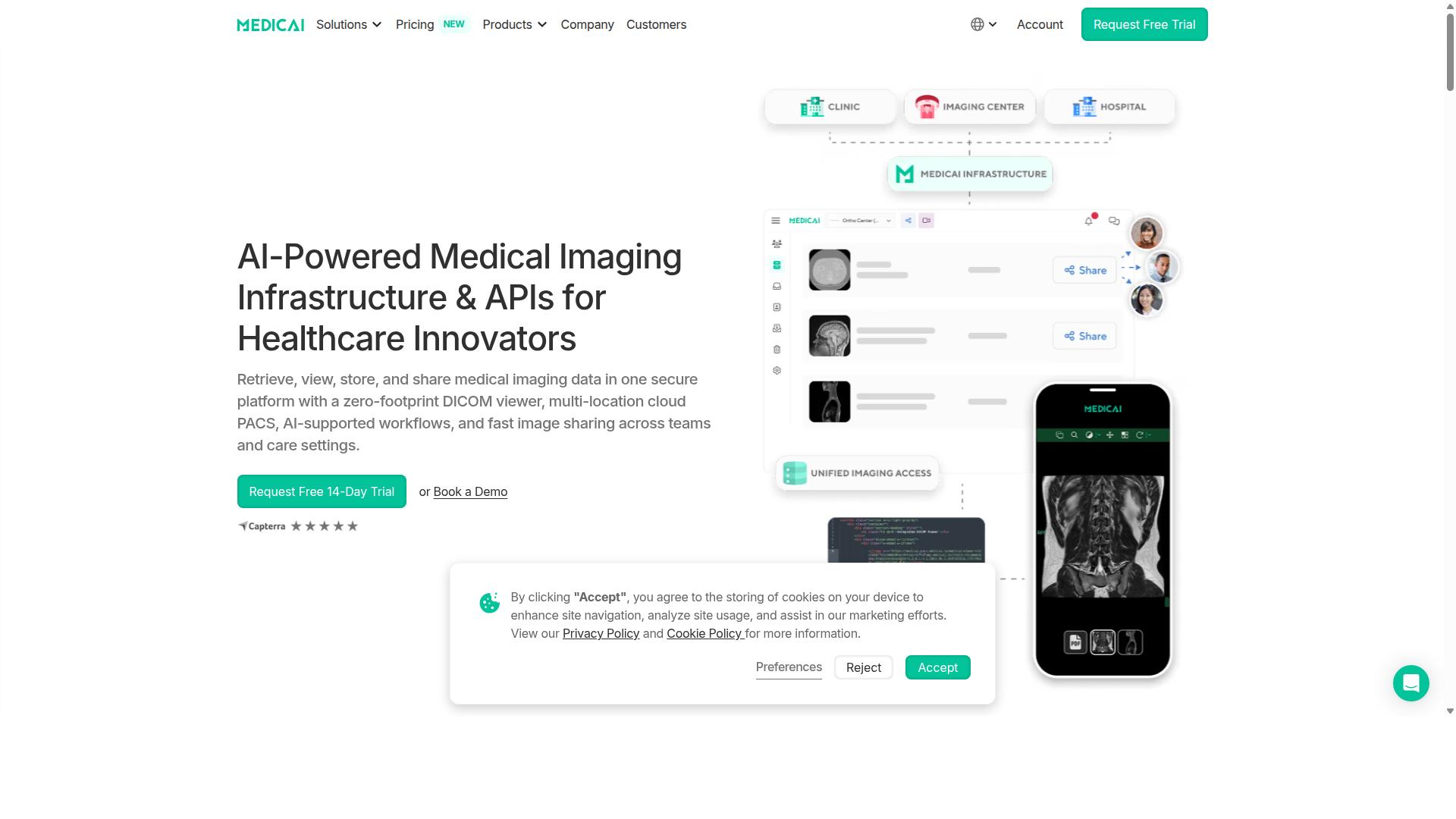
Medicai is a cloud-based medical imaging platform that enables healthcare providers to retrieve, view, store, and share medical imaging data in one secure platform with a zero-footprint DICOM viewer.
At its core, Medicai is a cloud PACS built for diagnostic image viewing. Instead of housing servers on site, imaging data lives in a secure cloud environment, so radiologists and clinicians can open studies from a browser without installing heavy workstation software.
That architecture removes the burden of on-premises hardware. There is no server room to maintain, no storage array to expand, and no local viewer to update. Providers get instant access to medical images from anywhere, which matters for radiology, teleradiology, and multi-site care teams that need images at the point of decision.
Medicai delivers this as Imaging Infrastructure as a Service (IIaaS), pairing multi-location cloud PACS with AI-supported workflows and fast image sharing across teams and care settings. For a 2026 buyer comparing cloud PACS options, that combination of zero-footprint viewing, interoperability, and infrastructure-as-a-service is the foundation everything else builds on.
Who Medicai Serves: Hospitals, Imaging Centers, and Specialty Care Providers
Medicai's target audience includes a wide range of healthcare providers, from large hospitals to specialized clinics.
Hospitals use cloud PACS to connect radiology departments across multiple locations. A multi-location cloud PACS means studies captured at one site are visible at another, which supports diagnostic radiology workflows and helps care teams avoid repeat imaging.
Imaging centers benefit from fast image sharing with referring physicians. Instead of burning CDs or managing courier deliveries, staff can share studies across care settings, which speeds up reporting and reduces administrative overhead.
Specialty care providers also rely on Medicai across a broad range of disciplines:
- Orthopedics and neurology, where serial imaging tracks change over time
- Oncology and radiology, where tumor boards review studies together
- Cardiology, ophthalmology, and pulmonology, each with modality-specific viewing needs
- Ob-gyn, dentistry, and gastroenterology, where images support routine and specialized care
Beyond clinical settings, Medicai serves virtual care providers, telemedicine platforms, and teleradiology services, plus personal injury lawyers, tumor boards, clinical trials, and medical education organizations. Patients can also access their own imaging through the Patient Portal.
The common thread is workflow. Remote access lets a specialist read from any location, and cloud delivery avoids the capital cost of maintaining physical servers. For a buyer evaluating cloud PACS in 2026, that breadth of served segments is a useful signal of how flexibly the platform fits different care models.
Why Medicai Is the Best Cloud PACS for Diagnostic Image Viewing in 2026
In 2026, Medicai stands out as a leading cloud PACS due to its advanced diagnostic viewing capabilities and proven track record. The platform combines a web-based DICOM viewer with a cloud image archive built for radiology teams that need fast, secure access to studies from any location.
Its track record is not theoretical. Medicai processes 1M+ studies per year, holds 1.7M+ studies in storage, and supports 10,000+ active doctors across 70 clinics and hospitals. That volume reflects a system trusted for everyday diagnostic image viewing, not just occasional use.
Scalability is central to the platform's design. With 2M+ imaging studies uploaded and 50M+ yearly API transactions, Medicai handles growing data loads without forcing clinics to manage on-site hardware or capacity planning. A Microsoft Azure partnership underpins this cloud infrastructure.
Reliability and compliance round out the case. Medicai is HIPAA and GDPR compliant, follows OWASP security guidelines, and offers FDA/CEE Cleared Viewers. For healthcare IT teams evaluating a Cloud PACS in 2026, that combination of scale, security, and regulatory clearance is exactly what a buyer's guide should prioritize.
Zero-Footprint DICOM Viewer and FDA/CEE-Cleared Diagnostic Viewing
Medicai's zero-footprint DICOM viewer requires no installation, providing instant access to diagnostic-quality images through a web browser. Radiologists and referring physicians open a study in the browser rather than installing desktop software on each workstation.
That approach solves a familiar healthcare IT problem. Traditional PACS clients demand per-machine installs, version updates, and operating system compatibility checks. A browser-based viewer removes those steps, so a clinician on a laptop, a tablet, or a shared workstation sees the same interface and the same study.
Diagnostic confidence depends on clearance and tooling. Medicai offers FDA/CEE Cleared Viewers, meaning the viewing environment is intended for diagnostic use rather than casual image review. The platform has recorded 300k+ visualizations of DICOM studies in the last year, evidence that remote reading is happening at real clinical scale.
For teleradiology, the zero-footprint model matters most. A specialist covering night shifts or a multidisciplinary tumor board across time zones can pull up a study without waiting on a software deployment. Medicai has been featured in press for enabling global multidisciplinary tumor boards and helping Ukrainian refugee patients access cancer treatments, both of which depend on remote diagnostic image viewing.
Compliance travels with the viewer. Because Medicai is HIPAA and GDPR compliant and follows OWASP security guidelines, browser access does not mean weaker protection. Access controls, audit trails, and encryption remain part of the same cloud environment that stores the image archive.
The practical result is faster reading and fewer IT tickets. Medicai reports that its platform reduces diagnosis time by 65%, a figure tied to streamlined access and workflow rather than any single feature. For a 2026 Cloud PACS buyer, a cleared, zero-footprint viewer backed by a proven study volume is a strong signal that diagnostic image viewing will hold up under daily clinical pressure.
Key Features That Set Medicai Apart
Medicai offers a comprehensive suite of features designed to streamline medical imaging workflows from end to end. Rather than treating image handling as a single task, the platform organizes its capabilities into four connected categories that mirror the real journey of a medical image.
Those categories are Connect & Retrieve, Store & Manage, Access & Visualize, and Collaborate. Together they cover the entire imaging lifecycle, from the moment a scan is captured to the point where a specialist reviews it and a patient receives the result.
For a buyer evaluating Cloud PACS options in 2026, this structure matters. A platform that only excels at storage but struggles with retrieval, viewing, or sharing creates gaps that radiology teams have to fill with manual workarounds. Medicai's design aims to close those gaps by keeping ingestion, archiving, diagnostic viewing, and communication within one environment.
The sections below break down what sits inside each category and why it matters for diagnostic image viewing.
Connect, Retrieve, Store, and Manage: From DICOM Gateway to Vendor Neutral Archive
Medicai's Connect & Retrieve and Store & Manage modules provide a seamless pipeline for ingesting, archiving, and managing medical images. On the intake side, the Medical Imaging Uploader and DICOM Gateway handle getting studies into the platform, whether they arrive from a modality, an outside facility, or a referring provider.
Once images are in, the Cloud PACS acts as the working environment for diagnostic radiology, while the Vendor Neutral Archive (VNA) provides long-term storage that is not tied to a single viewing application. This distinction matters for any buyer comparing systems. A VNA keeps an image archive portable and independent, which reduces the risk of being locked into one vendor's viewer or workflow.
Several other components support the lifecycle:
- Medical Image Exchange for moving studies between organizations and care settings
- Patient Case Management for organizing studies around the patient rather than the file
- Backup and Disaster Recovery to protect against data loss and support business continuity
Interoperability standards such as HL7, FHIR, and IHE are central to how these pieces communicate with hospital information systems and other clinical software. For healthcare IT teams, that standards-based approach reduces integration friction and supports compliance expectations around data security, access control, and audit trails.
Access, Visualize, Collaborate: Structured Reporting and Patient Imaging Portals
Medicai's Access & Visualize and Collaborate features enable radiologists and care teams with advanced tools for diagnosis and communication. The DICOM Viewer is a zero-footprint viewer, meaning diagnostic image viewing happens in a browser without a heavy local install. That is a meaningful advantage for teleradiology, where readers may work across multiple sites and devices.
Reporting is handled through Structured Reporting for Radiology, which supports consistent, organized output rather than free-text notes alone. Around that core, Medicai provides a Doctor Imaging Portal and a Patient Imaging Portal, giving clinicians and patients appropriate access to imaging results.
Collaboration extends further through several connected offerings:
- Medical Image Sharing Platform for distributing studies securely between authorized parties
- Teleradiology support for remote reading workflows
- Tumor Boards support for multidisciplinary case review
- Mobile Imaging App and Medicai Imaging API for access and integration beyond the desktop
AI also plays a role through the Radiology AI Co-Pilot and AI-Powered Diagnostics, which point to how machine learning can assist diagnostic radiology within the same environment. For a 2026 buyer, the value is a single platform where viewing, reporting, sharing, and patient engagement connect instead of fragmenting across separate tools.
How Medicai Performs at Scale: Track Record and Reliability
Medicai's platform is built to handle high volumes of imaging data with proven reliability and scalability. For a Cloud PACS evaluated in a 2026 buyer's guide, scale is not a marketing phrase. It is the difference between a system that holds up under daily radiology workloads and one that buckles when study volumes climb.
The numbers behind Medicai's track record show a platform already operating at production scale across real clinical environments.
- 1M+ studies transacted or processed per year
- 1.7M+ studies held in storage
- 2M+ imaging studies uploaded to date
- 300k+ visualizations of DICOM studies in the last year
- 50M+ yearly API transactions
- 70 clinics and hospitals on the platform
- 10,000+ active doctors using it
Those figures matter for diagnostic image viewing because they reflect sustained throughput, not a one-time peak. A cloud PACS that processes over a million studies a year and supports 10,000+ active doctors has already been stress-tested by the everyday demands of radiology and teleradiology.
Volume alone is not enough, though. Reliability depends on how the underlying cloud computing infrastructure is designed to keep imaging available when something goes wrong.
Medicai runs on a multi-provider cloud foundation rather than a single data center. The platform maintains partnerships with Microsoft Azure, AWS, and Hetzner, which supports redundancy and business continuity across providers. If one environment experiences disruption, the architecture is positioned to keep studies accessible instead of leaving clinicians locked out of the image archive.
For a buyer weighing a Cloud PACS, this matters for three practical reasons:
- Uptime and business continuity: distributed infrastructure reduces the risk that a single outage halts diagnostic image viewing.
- Latency and bandwidth: cloud delivery means images are streamed to the viewer rather than transferred as full files, which keeps diagnostic radiology responsive on typical clinical networks.
- Storage durability: with 1.7M+ studies in storage, the platform has demonstrated it can retain and serve a growing image archive over time.
Security and compliance sit alongside reliability. Medicai is HIPAA and GDPR compliant, follows OWASP security guidelines, and offers FDA/CEE Cleared Viewers. Those credentials matter in a market where data security, encryption, and access control are non-negotiable for any healthcare IT decision.
The platform has also been featured in press for enabling global multidisciplinary tumor boards and helping Ukrainian refugee patients access cancer treatments. That kind of use case depends on the same reliability at scale described above: clinicians in different locations viewing the same DICOM studies without delay.
For a buyer comparing Cloud PACS options in 2026, Medicai's scale metrics, multi-cloud redundancy, and compliance posture make a clear case. The platform has the volume, the infrastructure, and the track record to support diagnostic image viewing at an enterprise level.
Pricing and Plans
Medicai offers transparent monthly pricing with two main plans: Starter and Standard. Both tiers include unlimited user accounts, which matters for radiology groups and teleradiology practices where seat-based licensing can quietly inflate costs as a team grows. Instead of paying per reader, you pay for the storage and connected locations your workflow actually needs.
Here is how the two plans compare on the core numbers.
| Plan | Monthly Price | Cloud Storage | User Accounts | Connected Locations |
|---|---|---|---|---|
| Starter | $249/month | 500 GB | Unlimited | None |
| Standard | $749/month | 2 TB | Unlimited | One |
| Enterprise | Custom pricing | Custom | Unlimited | Multiple, plus multiple external locations |
The Starter plan at $249/month suits small practices, individual radiologists, and clinics that need a cloud image archive without tying the software to a physical imaging site. With 500 GB of cloud storage and no connected locations, it fits teams that upload and review studies remotely rather than pulling directly from on-site modalities.
The Standard plan at $749/month adds 2 TB of cloud storage and one connected location. That single connection is what many diagnostic imaging providers need to link a modality or on-site system to the cloud, making Standard the more natural fit for a facility running its own imaging equipment.
For larger organizations, Enterprise pricing is quoted individually. It covers custom cloud storage and multiple connected locations, along with multiple external locations, which is the tier to discuss when a health system or multi-site group needs a broader footprint.
Two additional costs are worth budgeting for. A DICOM Gateway Setup runs $1,000 one-time per location, so each connected site carries its own setup fee. Storage beyond your plan's allowance and any additional locations are also billed separately, which means the plan price is a starting point rather than the full picture for growing practices.
Billing is flexible. Monthly billing keeps commitments light, while yearly billing saves 15%, bringing Starter to $209/month and Standard to $639/month when paid yearly. Enterprise customers can also arrange per-study pricing, which can suit organizations with uneven imaging volumes.
A free 14-day trial of Starter plan features is included, and no credit card is required to start. One policy to note: refunds are not available for partial periods, so it is worth confirming the right tier before committing. Medicai's cloud model means these plans are available globally, since there is no on-premise hardware requirement beyond the gateway for connected locations.
For a 2026 buyer, the practical takeaway is to match the tier to your storage volume and location count first, then decide between monthly and yearly billing based on how confident you are in your long-term imaging needs.
Security, Compliance, and Trust Signals
Medicai prioritizes security and compliance, adhering to HIPAA and GDPR standards to protect sensitive medical data. For any Cloud PACS evaluated in this 2026 buyer's guide, security is not a checkbox. It is the foundation that determines whether a platform can be trusted with patient imaging at scale.
When you assess diagnostic image viewing platforms, look past the feature list. Ask how data is protected at rest, how it is protected in transit, who can access it, and what record exists of that access. These questions separate serious medical imaging software from generic cloud storage dressed up as a PACS.
Encryption should protect DICOM studies both at rest and in transit. In transit, TLS encryption guards data as it moves between modalities, viewers, and the image archive. At rest, encryption safeguards stored studies against unauthorized access even if underlying storage is compromised.
Access control matters just as much. Role-based permissions ensure that radiologists, technologists, and referring physicians see only what their role requires. Audit trails complete the picture by logging who viewed, uploaded, or modified a study, which supports both internal accountability and regulatory review.
Data residency is another decision point. Some healthcare organizations must keep patient data within specific jurisdictions. A Cloud PACS that offers regional storage options gives compliance teams flexibility, particularly for institutions operating across borders or serving international patients.
Medicai follows OWASP security guidelines, a recognized framework for reducing common application security risks. Combined with HIPAA and GDPR compliance, this signals that security is treated as an ongoing practice rather than a one-time certification.
For buyers in 2026, compliance documentation should be verifiable, not just claimed. Two frameworks matter most in medical imaging:
- HIPAA governs the handling of protected health information in the United States, covering administrative, physical, and technical safeguards.
- GDPR regulates personal data for individuals in the European Union, including health data, and imposes strict rules on storage, transfer, and consent.
Beyond privacy law, clinical software may also require regulatory clearance. Medicai offers FDA/CEE Cleared Viewers, which matters because diagnostic radiology tools used for interpretation often need clearance before clinical use. A platform that combines privacy compliance with cleared viewing technology covers both the legal and clinical sides of trust.
Trust also comes from the infrastructure a platform runs on. Medicai's partnership with Microsoft Azure places its cloud PACS on enterprise-grade cloud computing infrastructure with established reliability and security practices. For healthcare IT teams, building on a major cloud provider reduces the burden of validating underlying data center controls.
Adoption is another signal. Medicai reports 70 clinics and hospitals and 10,000+ active doctors on the platform, along with 2M+ imaging studies uploaded and 1.7M+ studies in storage. These figures indicate a platform handling real clinical volume, not a pilot project.
Independent recognition adds further weight. Medicai has been featured in press for enabling global multidisciplinary tumor boards and helping Ukrainian refugee patients access cancer treatments. That kind of coverage reflects how the platform performs under demanding, real-world conditions.
Security claims are easy to make and hard to verify. A practical evaluation for your buyer's checklist includes:
- Confirm encryption is applied to data at rest and in transit.
- Review role-based access control and whether permissions can be tailored to your organization.
- Ask for audit trail capabilities and how long logs are retained.
- Clarify data residency options and where studies are physically stored.
- Request evidence of HIPAA and GDPR compliance, plus any FDA or CEE clearances for viewer software.
- Check whether the vendor follows a recognized security framework such as OWASP guidelines.
Medicai addresses each of these areas through HIPAA and GDPR compliance, OWASP-aligned practices, FDA/CEE Cleared Viewers, and its Microsoft Azure partnership. For a Cloud PACS supporting diagnostic image viewing in 2026, that combination of compliance, cleared technology, and enterprise infrastructure makes Medicai a trustworthy choice for clinics, hospitals, and teleradiology teams.
Who Should Use Medicai
Medicai is ideal for a range of healthcare organizations seeking a scalable, secure cloud PACS. Its design suits providers that need diagnostic image viewing, image archiving, and multi-site collaboration without maintaining on-premise infrastructure. The platform serves both large health systems and smaller specialty practices.
The breadth of its target audience reflects how cloud computing has reshaped medical imaging. Hospitals, imaging centers, and specialty care providers all rely on fast, reliable access to DICOM studies. Medicai's cloud model removes much of the hardware burden that traditional PACS deployments carry.
Hospitals and Imaging Centers
Hospitals and imaging centers generate high volumes of diagnostic radiology studies daily. A cloud PACS must handle that load while keeping image retrieval quick for radiologists. Medicai supports these organizations by hosting the image archive in the cloud, which reduces dependence on local servers.
Imaging centers often serve referring physicians across a wide area. Cloud access lets those referrers view studies without installing specialized software. This matters for diagnostic image viewing workflows where speed and availability shape patient care.
Hospitals also face rising storage demands as study sizes grow. Medicai's architecture addresses these pressures by scaling with demand rather than requiring constant hardware refreshes.
Specialty Clinics
Specialty care providers represent a large part of Medicai's audience. The platform serves orthopedics, neurology, oncology, radiology, cardiology, ophthalmology, ob-gyn, pulmonology, dentistry, and gastroenterology practices. Each specialty brings distinct imaging needs, from musculoskeletal studies to cardiac and neurological scans.
A single-specialty clinic may not have the budget for a full on-premise PACS. Medicai offers a cloud-based alternative that scales to the practice's size. Clinicians can review images, share them with colleagues, and maintain a complete image archive without dedicated IT staff.
Specialty workflows also benefit from interoperability. Support for standards like HL7, FHIR, and IHE helps connect imaging data with other clinical systems. That connectivity supports coordinated care across departments and referring providers.
Teleradiology Groups and Virtual Care Providers
Teleradiology services depend on remote access to studies around the clock. Medicai fits this model by hosting images in the cloud, so radiologists can read from any location with a secure connection. Remote reading becomes a core workflow rather than an add-on.
Virtual care providers and telemedicine platforms also use Medicai to integrate imaging into broader virtual encounters. This supports continuity when a patient's care spans multiple sites or specialists.
For teleradiology groups covering several facilities, multi-site collaboration is essential. A cloud PACS lets readers pull studies from different locations into one environment. That reduces delays and keeps reporting consistent across the network.
Research, Education, and Other Users
Medicai's audience extends beyond direct clinical care. Tumor boards use the platform to review cases collaboratively. Clinical trials rely on organized image access for study protocols. Medical education organizations use it to teach imaging interpretation.
Personal injury lawyers also appear among Medicai's users, reflecting how imaging records support legal review. A vendor-neutral archive approach helps these varied users access studies without being locked to one imaging vendor.
Patients themselves are served through the Patient Portal. This gives individuals a way to access their own imaging records, which supports transparency and engagement in their care.
Where Medicai Excels
Certain scenarios highlight Medicai's strengths. Remote reading, multi-site collaboration, disaster recovery, and AI integration all align with a cloud-first design.
- Remote reading: Radiologists access studies from any secure location, supporting distributed teams.
- Multi-site collaboration: Providers across facilities share images and findings in one environment.
- Disaster recovery and business continuity: Cloud hosting reduces the risk of losing access when local systems fail.
- AI integration: Machine learning tools can be layered onto imaging workflows as the field advances.
These scenarios share a common thread: they reward organizations that need flexible, secure access rather than fixed on-premise infrastructure. Medicai's cloud PACS model is built for exactly that kind of demand.
For a 2026 buyer weighing cloud PACS options, the question is less about whether cloud fits and more about which provider matches your workflow. Medicai's range of users, from hospitals to specialty clinics to research groups, shows how broadly that fit can extend.
Final Verdict: Is Medicai the Right Cloud PACS for You?
After evaluating Medicai's features, performance, and pricing, it emerges as a strong contender for organizations seeking a cloud-based PACS. The platform pairs a zero-footprint viewer with FDA clearance, giving radiology teams a browser-based path to diagnostic image viewing without the burden of on-site infrastructure.
For a 2026 buyer's guide, three questions usually decide the shortlist: does the viewer support real diagnostic work, does it scale with the practice, and is the commercial model predictable? Medicai answers each of these directly rather than asking buyers to fill in the gaps.
Zero-footprint viewer. Because the viewer runs in the browser, there is no thick client to install and no workstation refresh cycle to plan around. That matters for teleradiology, where readers may be off-site, and for healthcare IT teams that want fewer endpoints to manage.
FDA clearance. For diagnostic radiology, regulatory status is not a nice-to-have. An FDA-cleared viewer signals the software has been reviewed for its intended clinical use, which is a meaningful threshold when comparing cloud PACS options.
Scalability. Storage and compute needs in medical imaging rarely stay flat. A cloud model lets a practice add volume without a hardware purchase, which suits both a growing clinic and a hospital department with uneven demand.
Transparent pricing. Buyers in this category often struggle to get straight answers on cost. Medicai's approach removes that friction, which helps smaller teams budget with confidence instead of negotiating blind.
Security posture. Data security, encryption, access control, and audit trails are table stakes for HIPAA compliance and, where relevant, GDPR. These are the controls that let a cloud image archive meet the same expectations as an on-premises system.
No platform is the right fit for every organization, so it is worth weighing the trade-offs honestly. A cloud-first architecture means dependence on network bandwidth and uptime, and teams with deeply customized on-premises workflows may need to adjust processes during migration.
On the other side of the ledger, Medicai removes capital expenditure on servers, eliminates much of the maintenance burden, and gives distributed reading teams a consistent experience. For most practices, the operational gains outweigh the transition effort.
- Small clinics and private practices: a strong fit. Low infrastructure overhead and predictable pricing matter more than raw enterprise configurability at this scale.
- Imaging centers and teleradiology groups: a strong fit. Browser-based diagnostic image viewing supports readers working across multiple locations.
- Large hospitals and health systems: a viable option where cloud adoption, interoperability via HL7 and FHIR, and vendor-neutral archive strategy are already priorities.
The clearest way to decide is to map Medicai's capabilities against your own volume, workflow, and compliance requirements. If your priorities are a zero-footprint viewer, FDA clearance, scalable storage, transparent pricing, and a serious security foundation, Medicai deserves a place at the top of your evaluation list.
Sales inquiries can be directed to [email protected]. Medicai USA is located at 7901 4th St N, STE 300, St. Petersburg, FL, 33702, and can be reached at +1 (832) 220 1035. Medicai Romania is located at 53-55 N Filipescu, 5th Floor, Sector 2, Bucharest, 020961, and can be reached at +40 316 305 875.
Frequently Asked Questions
What should I look for in a cloud PACS for diagnostic image viewing?
Priorities include a zero-footprint DICOM viewer that loads quickly in a browser, regulatory clearance for diagnostic use (such as FDA/CEE-cleared viewers), and compliance with HIPAA and GDPR. You should also assess storage scalability, image exchange capabilities, and how easily the platform connects to your existing systems via a DICOM Gateway. Medicai, for example, combines retrieval, viewing, storage, and sharing in one secure cloud platform with a zero-footprint DICOM viewer.
Is Medicai a full cloud PACS or just a DICOM viewer?
Medicai is a cloud-based medical imaging platform, not just a viewer. It covers the full workflow: Connect & Retrieve (Medical Imaging Uploader, DICOM Gateway), Store & Manage (Cloud PACS, Medical Image Exchange, Patient Case Management, Vendor Neutral Archive, Backup and Disaster Recovery), and Access, Visualize, Collaborate. This means providers can retrieve, view, store, and share imaging data in one secure platform.
How much does Medicai cost?
Medicai offers transparent monthly billing: Starter at $249/month with 500 GB cloud storage and unlimited user accounts, and Standard at $749/month with 2 TB cloud storage, unlimited user accounts, and one connected location. An Enterprise tier with custom pricing is available for organizations needing more. Note that the Starter plan does not include connected locations, so if you need DICOM Gateway connectivity, Standard or Enterprise is likely the better fit.
Is Medicai secure and compliant for clinical use?
Yes. Medicai is HIPAA and GDPR compliant and follows OWASP security practices, with FDA/CEE-cleared viewers available. The platform is used globally, with over 1 million studies transacted or processed per year and 1.7 million+ studies in storage. For buyers, this combination of compliance and real-world volume is a useful signal when evaluating diagnostic viewing reliability.
Can Medicai handle multi-location and specialty imaging workflows?
Medicai is built for multi-location cloud imaging and serves hospitals, imaging centers, and specialty providers including orthopedics, neurology, oncology, radiology, cardiology, ophthalmology, ob-gyn, pulmonology, dentistry, gastroenterology, and virtual care. Its DICOM Gateway and Medical Image Exchange support sharing across sites, while Patient Case Management helps teams collaborate on complex cases. If you operate across multiple sites, check plan limits on connected locations before choosing a tier.
How do I evaluate vendors like Medicai against other cloud PACS options?
Start with a structured demo and a pilot using your own studies, then compare viewer performance, workflow fit, compliance documentation, and total cost. Ask each vendor for specifics on storage limits, connected locations, integrations, and support SLAs rather than relying on general marketing claims. Medicai offers a zero-footprint viewer, cloud PACS, VNA, and disaster recovery in one platform, and you can request a demo or contact [email protected] to assess fit for your organization.
Recommended Resources: